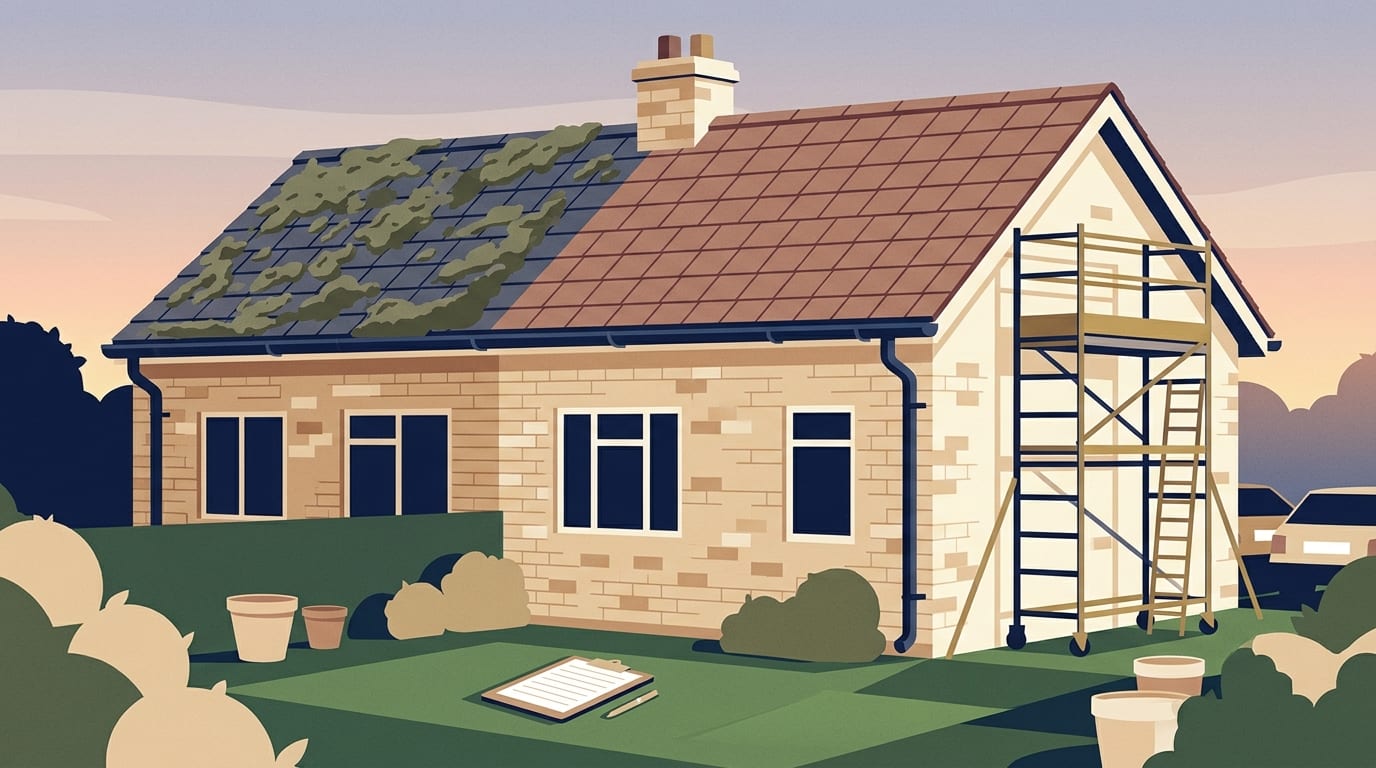
Typical 2026 prices put an average roof clean on a semi-detached house at around £475. Larger detached homes and jobs needing scaffolding can reach £900. Rates of £8 to £15 per square metre apply for pressure washing and for moss removal with a biocide treatment. These are typical costs that vary by roof and region, and London and the South East are said to cost more.
Roof work is priced per job according to the size of the property, the access required and the chosen cleaning method. A quote is a fixed price, whereas an estimate is not.
Roof cleaning prices by house type
The amount you pay depends heavily on the size of your property and how long the job takes. The table below outlines typical timeframes and labour costs for a pressure wash on homes with good access.
|
Property type |
Typical time |
Typical price |
|---|---|---|
|
Detached house |
6 to 7 hours |
£550 to £900 |
|
Semi-detached house |
4 to 5 hours |
£400 to £550 |
|
Terraced house |
3 to 4 hours |
£400 to £550 |
|
Bungalow |
3 to 5 hours |
£350 to £500 |
These figures are typical published prices for 2026 and local quotes will differ. Estimates vary. Some 2026 price lists put a semi-detached roof clean at £400 to £550, others at £400 to £800 for a manual scrape. The whole-roof prices below are a separate set, so they are not added to the table above.
For a mid-terrace house with a 40 to 50 square metre roof, a manual scrape usually costs between £350 and £650. Adding a biocide treatment pushes this to between £450 and £800. A semi-detached roof of 55 to 70 square metres typically costs £400 to £800 for a scrape, or £500 to £1,000 with a biocide treatment.
Larger detached homes with 80 to 100 square metres of roof space range from £600 to £1,100 for a manual scrape. This rises to between £750 and £1,400 with a biocide treatment. A bungalow roof of 70 to 90 square metres normally costs £500 to £900 for a scrape and £600 to £1,100 with biocide.
If you just need a garage or a small extension cleaned, covering 15 to 25 square metres, expect to pay £150 to £350 for a scrape. This increases to between £200 and £450 if the roof is treated afterwards. Steep roofs, three-storey houses and slate roofs sit at the top of each of these price ranges.
Prices by cleaning method
The approach your contractor takes will change the final bill. The table below compares four common methods for an average semi-detached home.
|
Cleaning method |
Price per square metre |
Typical semi-detached price |
|---|---|---|
|
Pressure washing |
£8 to £15 |
£400 to £550 |
|
Moss removal and biocide |
£8 to £15 |
£400 to £600 |
|
Soft washing |
£10 to £20 |
£450 to £650 |
|
Steam cleaning |
£11 to £25 |
£500 to £750 |
These are typical published prices for 2026 and your local quotes will differ based on the contractor. Pressure washing is the cheapest option on paper, but tile manufacturers advise against high pressure on roofs and most roofing professionals do not recommend it.
High pressure water can strip the colour from concrete tiles and force water under the interlocks. On clay tiles, delamination can follow. Moss absorbs moisture and keeps tiles damp after rain, and high pressure washing can damage roof tiles, particularly older or more delicate ones.
A manual scrape avoids high pressure water, and a biocide treatment can be added to it. With a biocide treatment on its own, the moss dies over three to six months and weathers off.
A soft washing treatment costs more but kills moss and lichen at the root. The contractor applies a low pressure biocide to the roof and leaves the rain to do the rinsing over the following weeks.
What adds to the price
A basic quote often covers just the roof clean itself. You might need to budget for extra services or equipment to complete the job safely.
Scaffolding can be a major extra cost, and estimates differ. Some 2026 price lists put it at £650 to £950 where it is needed, while others say scaffolding is rarely needed and give no figure.
Clearing out the gutters is sometimes included in the main quote. If it is charged separately, a gutter clear-out costs £80 to £200. Estimates differ on biocide: about £100 over a manual scrape alone, or £25 to £50 if added separately. If you book a biocide treatment on its own without any scraping, expect to pay £250 to £500.
Cleaning a conservatory roof is priced as an extra at £70 to £120.
The cleaner might spot problems once the moss is gone. Minor roof repairs start from around £60. Replacing a standard roof tile costs around £215, and a ridge tile replacement starts from around £225.
What affects how much your roof costs
Every roof is different and professional contractors price each job on its own merits. The main things that push a quote up or down include the cleaning method, the roof material and the location.
Pressure washing is generally the cheapest method, while steam cleaning and soft washing cost more. Older clay or slate tiles demand careful handling and gentler cleaning methods, which can affect the price.
Steep roofs and three-storey homes are harder to work on safely. These properties sit at the top of the price ranges.
A roof covered in heavy, established moss costs more to clear than a light covering of algae, because the extent of the moss and algae is a price factor.
Access matters too, including pitch, height and whether scaffolding is needed.
Prices vary by location. London and the South East are said to cost more, although no figures are available.
How long a roof stays clean
A professional clean is not a permanent solution, and treatments do not last forever. A scrape combined with a biocide treatment usually keeps regrowth down for two to four years.
If you opt for a manual scrape without biocide, the roof will green over much sooner. North-facing roofs and those shaded by large trees regrow fastest. A shaded or north-facing roof typically needs cleaning every five to ten years.
Tile manufacturers recommend a simple visual check once a year. They suggest general maintenance every three to five years. Low to moderate growth is best left alone unless your roof is leaking or the moss is blocking your gutters.
Why roof work is left to professionals
Homeowners should never go onto a roof or attempt to clean it themselves. The Health and Safety Executive (HSE) notes that almost one in five deaths in construction work involve roof work. The main causes are falls from roof edges or openings, and falling through fragile roofs and rooflights.
HSE treats all roofs as fragile until a competent person has confirmed they are not. The work must be planned carefully, usually with a written method statement, and those doing it must be trained, competent and instructed. The Work at Height Regulations 2005 require work at height to be properly planned and avoided where reasonably practicable.
You should never use a ladder, a roof walk or a pressure washer on a roof. Leave the job entirely to experts who have the right access equipment and fall protection.
Chemical treatments also carry strict rules. HSE guidance on biocides states that members of the public should never use products intended only for professional users. You must read and understand the label before using any biocidal product. Only authorised or approved biocides carry an authorisation or approval number, and users are responsible for disposing of waste and empty containers safely.
What a good roof cleaning quote includes
When comparing prices, make sure you know exactly what each contractor is offering. A cheap quote might leave out important steps or use methods that put your tiles at risk. Ask these specific questions before you agree to the work.
- Which cleaning method will you use and is it safe for my specific tiles?
- Does the price include a biocide treatment to delay regrowth?
- Will you survey the roof first to check for damage?
- How do you handle fall protection and access to the roof?
- Is clearing the gutters included in the final price?
- How will you protect my plants, drains and gutters from moss and chemicals?
- Which biocide product do you use and is it authorised for this surface?
- What interval do you expect before the roof needs cleaning again?
Ask for a fixed quote rather than an estimate. Ensure the quote is itemised so you can see the cost of the clean, the chemical treatment and any access equipment separately. A service agreed on the doorstep, by phone or online normally carries a 14-day cooling-off period.
Watch out for cold callers at the door who offer to clean the roof immediately, or tradespeople who carry out a clean without agreement and then post a bill. Never pay months in advance. Under the Consumer Rights Act 2015 a service must be carried out with reasonable care and skill, and if it is not you can ask for it to be put right or for money back.
Check that the firm holds current public liability insurance. This is not a legal requirement, but it is the cover that pays out if a cleaner damages your property or injures someone, so you should always ask to see a current certificate.
Common questions
Does a roof clean include the gutters?
Clearing the gutters is not always included in a standard roof clean quote. Check your quote to see if this is bundled into the main price or charged as a separate item costing £80 to £200.
What is the best way to clean moss from a roof?
Pressure washing is the cheapest method on paper, but most roofing professionals do not recommend high pressure washing because it can damage roof tiles. Ask any contractor why they recommend their method. With a biocide treatment on its own, the moss dies over three to six months and weathers off.
How do professionals clean a tile roof?
Methods differ. A soft wash applies a low pressure biocide that kills moss and lichen at the root, and rain does the rinsing over the following weeks. Ask the contractor how they will reach the roof and how they handle fall protection.
Can you clean a roof from the ground?
Access varies and so does the price, so ask whether scaffolding is needed. Ask how the contractor will reach the roof and handle fall protection, and never go onto the roof yourself.
What to do next
Before you book a contractor to clean your roof, take these practical steps to protect your property and ensure you get a fair price.
- Check your roof material, because older clay or slate may need gentler methods.
- Gather three itemised quotes to compare prices and methods in your area.
- Ask each contractor for a current public liability insurance certificate.
- Confirm that all workers will use proper fall protection or clean from the ground.
- Agree in writing whether clearing the gutters and applying a biocide treatment are included.
- Point out any overhead cables to the cleaner before they start work with long poles.
Taking the time to ask the right questions helps you compare quotes fairly. When you are ready to compare quotes and speak to local professionals, you can find a window cleaner near you to see who offers roof scraping and soft washing services in your area.
Find a top rated window cleaner near you
1,651 window cleaners across the UK, each ranked on their Google rating and the number of reviews behind it. Start with your county: