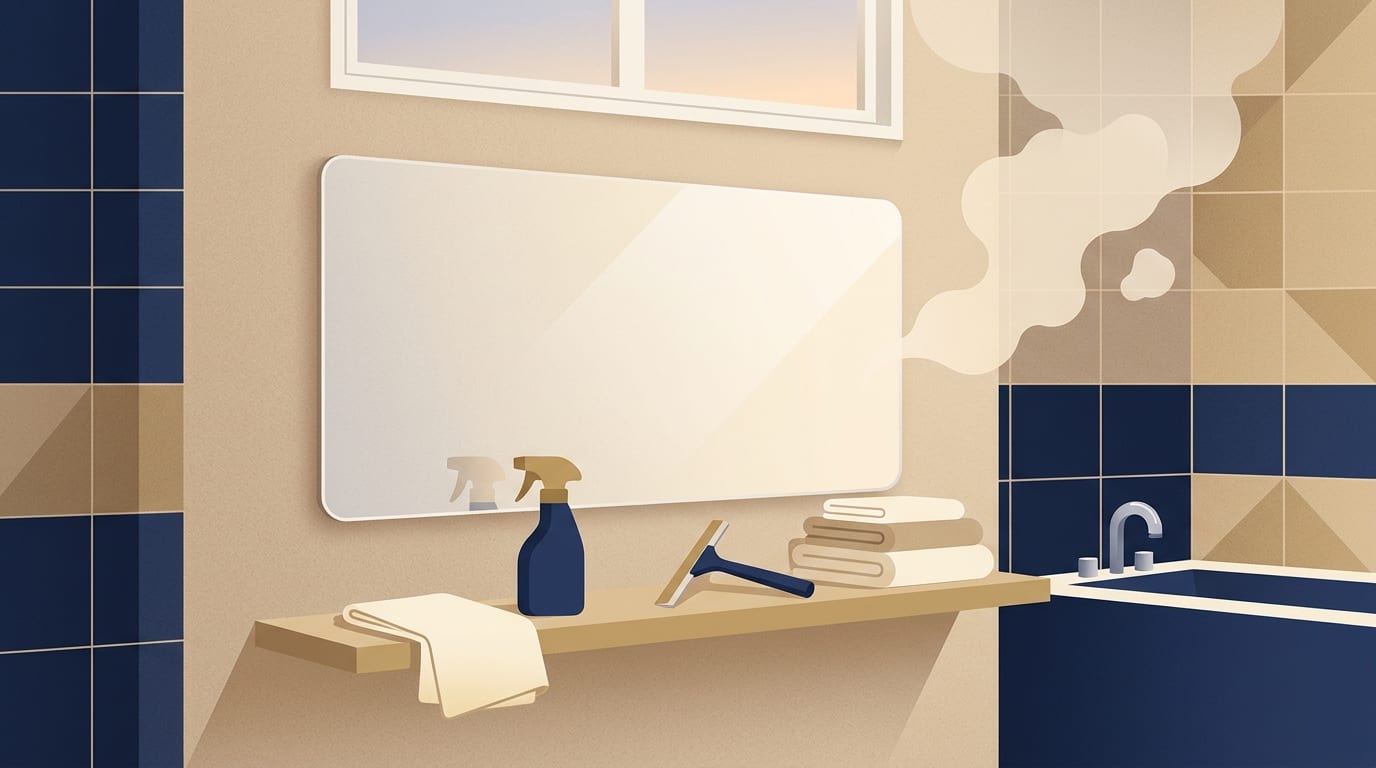
To clean a mirror without streaks, dust the glass first and apply your cleaning liquid to a cloth rather than spraying the mirror directly. Wipe the glass in a top-to-bottom zigzag motion so you cover the entire surface evenly. Finish by buffing the glass completely dry at once using a second clean, lint-free microfibre cloth.
How to clean a mirror without streaks
You can leave your glass completely clear by following a precise wiping method. This approach avoids driving moisture into the edges of the mirror.
- Wipe the mirror with a dry cloth to remove loose surface dust.
- Apply a small amount of plain water or a suitable liquid directly to a clean microfibre cloth.
- Wipe the glass working from the top to the bottom in a continuous zigzag movement.
- Use a second dry lint-free microfibre cloth to buff the glass immediately so no streaks remain.
- Rub the outside edges of the mirror completely dry to protect the backing.
What a mirror is made of and why the edges matter
A mirror is a glass plate with a silver or aluminium coating and several lacquer layers. This layered construction means the edge area is the most fragile part of the mirror. Damage to that coating can make the edges darken or rust over time. Unsuitable detergents and water left sitting at the edges are the main risks to a mirror.
You must dry the edges carefully since water left there can cause damage. Rub the edges completely dry after cleaning and avoid spraying or wiping heavy liquid onto them. Glass or window cleaners can attack and discolour the mirror film at the edges. You should keep them off the edges entirely or dry those areas thoroughly if they do come into contact with liquid.
Direct spraying drives moisture behind the glass and damages the silver backing. Cloudiness that stays after cleaning may mean the backing is worn from harsh solvents, and the mirror may then need replacing.
Which cloths and liquids to use
You should use no detergent if possible, as plain water and simple household remedies are usually enough for domestic mirrors. Distilled water works well for light marks and is preferred for rinsing because tap water can leave white spots. To clean with distilled water, apply it to one microfibre cloth, wipe the glass, and buff dry with a second cloth.
A 50:50 vinegar and water mix in a bottle is a common homemade option that helps get rid of streaks. You should avoid cleaners with soaps and scents because the additives leave residues that cause streaks. If you do use a commercial product, use one designed for the surface and follow the label. Never mix cleaning products.
Lint-free microfibre cloths are the best choice because they leave no residue and avoid leaving fibres on the glass. Avoid rough fibres that can scratch the surface. You should avoid paper towels, which can scratch, and old t-shirts or rags, which can leave residue. Newspaper is an alternative, but you must use black and white print only, as glossy paper makes a mess.
Cleaning a bathroom mirror and clearing fog
Bathroom mirrors face heavy moisture, so you must clear steam efficiently to protect the backing. Run the extractor fan during and after showering to extract damp air from the room. You should wipe the mirror with a squeegee afterwards to remove surface moisture before deposits form.
For heavily misted bathroom mirrors, a squeegee or a window vacuum can remove moisture quickly. A hairdryer held briefly toward the glass also works well to clear steam.
Before you start a deep clean in the bathroom, remove items such as soap dispensers and toothbrushes from below the mirror. You should also cover water-sensitive surfaces or floors beneath the glass to protect them from drips.
Removing hairspray, toothpaste and sticky marks
For greasy marks such as hairspray, use a soft damp cloth with a little washing-up liquid, then rinse with clean water. Another reported method for hairspray is to apply a small amount of rubbing alcohol to a microfibre cloth and wipe the area.
Dried toothpaste requires a gentler approach to avoid scratching the glass. Place a damp microfibre cloth briefly over the toothpaste splatter to soften the residue, then wipe it away and buff the glass dry.
For stubborn soap scum or thick dried toothpaste, apply glass cleaner only to the specific spots and wipe gently. Do not spread the cleaner over the rest of the mirror. Always wipe from side to side or in a zigzag pattern rather than wiping in circles.
Cleaning LED, heated and anti fog mirrors
Modern vanity mirrors require specific care to avoid damaging their internal components and specialist coatings.
- Switch off and unplug LED mirrors before you start cleaning.
- Keep the cleaner away from the light strip and the frame edges on an LED mirror.
- Dry the frame of an LED mirror completely separately from the glass.
- Wipe heated and demister mirrors with only a lightly dampened microfibre cloth.
- Avoid chemical cleaners and excess moisture on heated mirrors to protect the heated pad behind the glass.
- Avoid ammonia based cleaners on anti-fog and vanity mirrors because ammonia strips the coating.
What not to use on a mirror
Avoid solvent vapours such as nail varnish remover, which can affect the mirror and damage the protective lacquer layers. Harsh solvents can also wear down the backing.
You should avoid cleaning a mirror in direct sunlight. Work in the shade where you can.
If you notice cloudiness on the glass, it may come from a residue build up. A vinegar solution can remove this over a few cleans. If the cloudiness persists despite cleaning, the backing may be worn and the mirror may need replacing.
When a professional cleaner is worth it
You might want to hire a professional for very large, high or fixed wall mirrors, or when upstairs glass is involved. Never climb steps or lean out of upper windows to reach a high mirror. A professional window cleaner has the right equipment and knows how to clean outside windows safely.
Inside window cleaning is usually priced as an add on to a regular exterior clean, which will increase your overall inside window cleaning costs. Always agree exactly what is included before the work starts. Common problems include nothing being agreed about frames, sills, doors or the conservatory. You should also watch out for cold callers who claim to be the usual cleaner and ask for payment. Never accept cleans carried out without agreement and followed by a bill, and avoid paying months in advance.
Window cleaners use one of two methods. Traditional cleaning uses an applicator, squeegee and cloth, while water-fed pole cleaning is described below.
How professional exterior window cleaning works
Most domestic window cleaning is done on a round. The same cleaner returns on a set cycle, commonly every four, six or eight weeks. Work is priced per visit according to the size of the property, the number and type of windows, access and frequency. It is not priced by the hour. A first clean or a one-off clean usually costs more than a regular visit. Extras are priced on top, including inside glass, conservatory roofs, roof windows, glazed doors, fascias and gutters. London and the South East cost more.
For exterior glass, many professionals use water-fed pole cleaning. This uses a telescopic pole with a brush head, fed with purified water from a tank in the van or a trolley. The glass is scrubbed, rinsed and left wet. Because the minerals have been filtered out, the water is meant to dry without marks. Frames and sills are usually washed too. A first pole clean can leave some spotting until old residue has been rinsed out, so you should avoid judging a pole clean on the first visit.
Industry guidance produced with the HSE says water-fed poles must not be used near overhead power lines. You should point out any overhead cable to the cleaner before they begin work.
Commercial work is normally quoted per site and run as a contract with an agreed frequency. This includes a written risk assessment and method statement. Taller buildings may need powered access platforms or rope access.
Rules and protections for window cleaning
Ladders are not banned. The Health and Safety Executive (HSE) says ladders can be a sensible option for low risk, short duration work, including domestic window cleaning on lower floors. The Work at Height Regulations 2005 require work at height to be properly planned, done by competent people and avoided where reasonably practicable. This is why many cleaners now work from the ground with poles. The law asks for competence, not a formal qualification.
In Scotland, most councils require window cleaners to hold a window cleaner's licence under the Civic Government (Scotland) Act 1982. Licence holders carry identification, though requirements vary by council. Do not expect window cleaners elsewhere in the UK to be licensed.
Employers' liability insurance is compulsory for a business with employees. Public liability insurance is not a legal requirement, but it is the cover that pays if a cleaner damages property or injures someone, so you should ask for a current certificate.
The Federation of Window Cleaners, established in 1947, is a non-profit trade body with a code of practice, a safety accreditation scheme and training. Membership is voluntary, so treat it as one good sign among several.
Under the Consumer Rights Act 2015, a service must be carried out with reasonable care and skill. If it is not, the customer can ask for it to be put right or for money back. A quote is a fixed price, but an estimate is not. A service agreed on the doorstep, by phone or online normally carries a 14-day cooling-off period.
Common questions
How do you clean a mirror with vinegar?
Mix a 50:50 solution of plain vinegar and water in a bottle. Apply a small amount of this mixture to a microfibre cloth rather than spraying the glass directly. Wipe the mirror in a zigzag motion and buff it completely dry with a second lint-free cloth.
Why does my mirror look cloudy?
Cloudiness may come from a build up of residue on the glass, which vinegar can clear over a few cleans. If the cloudiness persists, the backing may be worn from harsh solvents and the mirror may need replacing.
How can I stop streaks appearing?
Streaks can come from cleaning products that contain soaps and scents, because the additives leave residues. Switch to plain or distilled water and always buff the glass dry immediately with a second clean microfibre cloth. You should also avoid cleaning the mirror in direct sunlight.
How do you clean a foggy mirror quickly?
You can remove moisture quickly using a squeegee, a window vacuum, or by pointing a hairdryer briefly at the glass. To prevent fog from building up in the future, run the bathroom extractor fan during and after your shower.
How do you clean a mirror without scratching it?
To avoid scratching the glass, you must use a soft cloth to loosen dirt before you wipe the surface. You should always finish the job with a lint-free microfibre cloth. Avoid using paper towels or rough fibres, as paper towels can scratch.
What to do next
Before you clean your mirrors, check you have the right materials and know exactly what type of mirror you are dealing with.
- Check whether your mirror is heated, LED or has an anti-fog coating.
- Unplug electrical mirrors and switch off the power at the wall.
- Gather two clean and completely dry lint-free microfibre cloths.
- Mix plain or distilled water with vinegar if you need a cleaning solution.
- Move water-sensitive items and cover the surfaces below the mirror.
If you have very large wall mirrors, high glass or exterior windows that need attention, you might prefer to hire a professional. You can find a window cleaner near you to deal with difficult glass.
Find a top rated window cleaner near you
1,651 window cleaners across the UK, each ranked on their Google rating and the number of reviews behind it. Start with your county: