
How to Remove Water Marks and Hard Water Stains From Glass
TopRatedWindowCleaners.co.uk · 7 October 2026
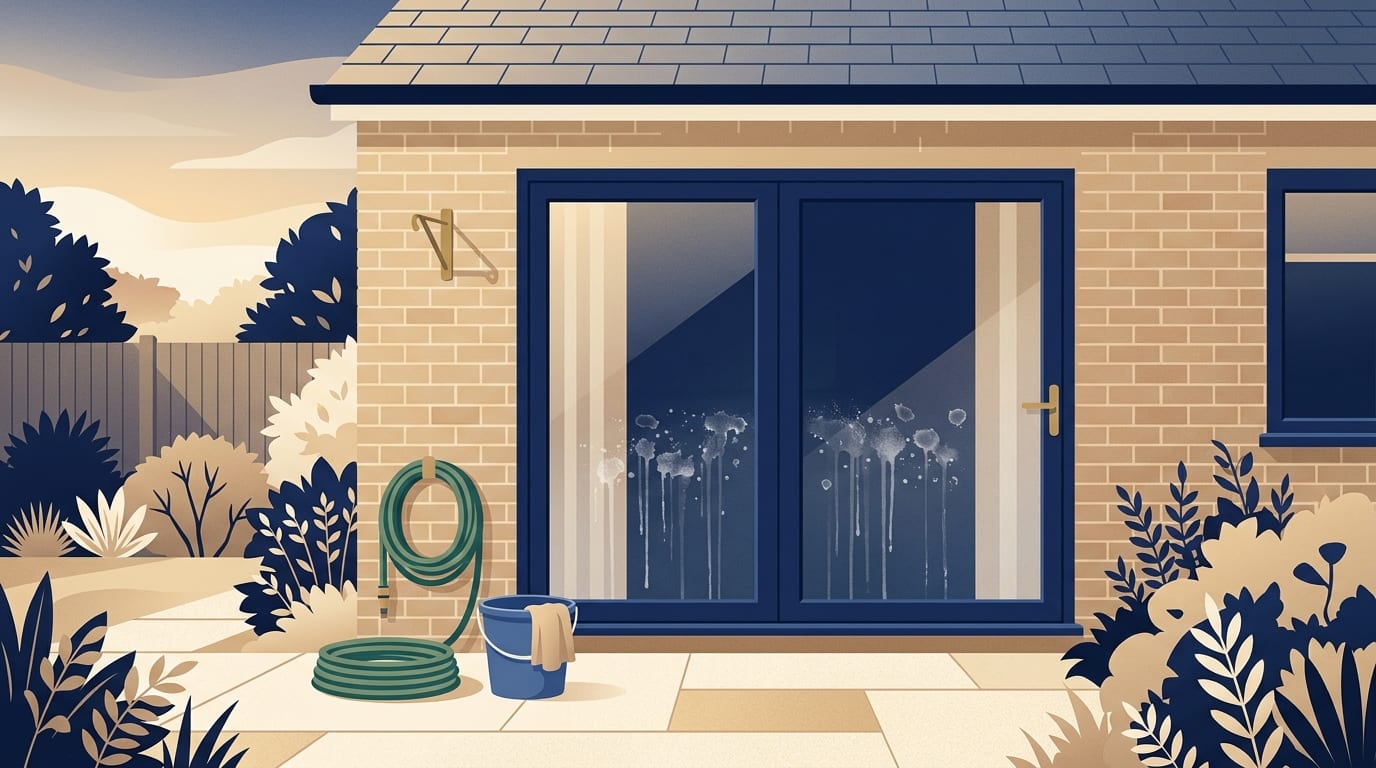
Most water marks on glass are mineral deposits left behind when hard water dries on the surface. Fresh marks usually come off with clean water, a little mild detergent and a soft rinse. Older deposits often need a household limescale remover used gently, while marks that refuse to move might mean the glass surface itself has been etched.
What water marks on glass are
Glass is very durable, but alkaline solutions and some acids can damage it. If you leave visible deposits on the glass, they can slowly attack the surface over time. Leaching and efflorescence from concrete, bricks and mortar are particularly harmful to windows and doors.
Some deposits are not harmful in themselves but hold moisture against the pane. This moisture can cause staining and etching of the glass if you ignore it. Other deposits become so firmly attached over time that the aggressive cleaning needed to remove them damages the glass itself.
It always pays to deal with spots and streaks early before they have time to cause lasting harm. Normal dirt is easily washed away, but mineral deposits require a different approach. If your marks look like smears from poor cleaning technique rather than hard water, look at how to clean windows without streaks.
Why hard water leaves white spots
The Drinking Water Inspectorate explains that water hardness is caused by dissolved calcium and magnesium. Depending on the local geology, the hardness of the water supply varies from place to place. When you hose a window or leave hard water to dry on the glass, the water evaporates and leaves those dissolved minerals behind as white spots.
Hard water is a common problem in many regions and also leaves tide marks on basins, sinks, baths and toilets. The official hardness bands measure the mineral content in milligrams per litre as calcium carbonate. The Drinking Water Inspectorate's hardness bands are:
- Soft water contains up to 100 milligrams per litre.
- Slightly hard water measures between 100 and 150.
- Moderately hard water falls between 150 and 200.
- Hard water contains between 200 and 300.
- Very hard water has more than 300 milligrams per litre.
For an accurate measurement of your local supply, ask your water company, because there is local variation.
Other causes of white streaks and stains
Hard water from a hose is not the only reason a window turns cloudy. White streaks running down glass, particularly on conservatory roofs, can come from run-off from untreated lead flashing. You should remove these streaks as soon as possible with a soft cloth, without using any abrasives.
White streaks can also appear when rain runs off silicone sealant between the window frame and the building. Run-off from rusting steel can also be particularly harmful to glass.
Sometimes, streaking across the pane is the re-deposition of dirt and detergent. This happens when too little cleaning or rinsing solution is used during the wash. You can prevent this by using enough water to flush the dirt away completely.
How to remove fresh spots and stubborn limescale
Every type of glass can be scratched by an improper cleaning method. There is usually a layer of abrasive dust on glass, which can scratch it if you use too much pressure with too little cleaning solution. You must flood the surface generously with plenty of clean water first to float off dust, sand and grit.
Keep your cloths and squeegees clean and in good condition throughout the job. Wash the glass with a mild detergent solution and a soft lint-free cloth. To minimise marks in the summer months, do not hose the glass at the hottest time of day.
If the glass still does not look clean, rinse it with soft or distilled water after the detergent wash, before the solution dries. This ensures the final thin film of pure water evaporates without leaving visible deposits. One maker of coated glass says rinse water should not be hard and recommends soft or distilled water.
If dried water spots or deposits appear after the glass has been hosed with water that was too hard, normal washing might not shift them. Glass manufacturers state that hard water marks can be removed with a mild household limescale remover. You must dab or wipe the cleanser on gently, without rubbing, and then rinse it off thoroughly with water.
Always follow the directions on the specific product you choose. Clean a small area first and check no damage occurs before you tackle the whole pane. Do not allow water or cleaning solutions to remain on glass surfaces or window components.
If you have self-cleaning glass, you should not use abrasives. If your water is hard, the manufacturer advises using a domestic water softener or adding a couple of drops of washing-up detergent per litre of rinsing water. Find out more about how self-cleaning glass works.
What not to use on glass and frames
It is tempting to scrape away a stubborn calcium deposit, but glass makers test different methods and warn strongly against abrasive tools. Do not let sharp, rough or hard objects touch the glass. You should also avoid cleaning tinted or coated glass in direct sunlight.
In one glass maker's tests, a steel blade scratched both toughened and non-toughened glass, even with plenty of water. Aggressive cleaning can damage the glass, so do not use any of these:
- Scrapers or razor blades, which can scratch the glass.
- Wire wool or steel wool.
- Scouring pads.
- Abrasive cleaning solutions and creams.
When you treat a hard water stain, keep cleaning products and solvents off glass sealants, framing and adjacent paintwork. One window maker's care guide lists products not to use on uPVC frames, and warns that cellulose thinners melt plastic.
Do not use glass cleaner, bleach, methylated spirits, white spirit, WD40, cream cleaners, scouring powder or other abrasive cleaners on uPVC frames. You must also avoid caustic or ammonia-based cleaners, steel wool or scouring pads.
When the marks will not come off
If a stain refuses to lift, the surface of the glass may be damaged rather than just dirty. In most cases, surface damage to glass in windows, doors and conservatories can be repaired by a glass repair specialist. This includes damage caused by building run-off, sealant leakage and airborne contamination such as road film.
A specialist will survey the damage and quote for the work. In many cases replacing the glass may be the most economical option. Repair can be cost effective where replacement would be far more expensive, for example a large landing window. One glass maker does not treat residue that can be cleaned off, or that is only visible when moisture such as rain or condensation is on the glass, as a glass defect.
If a tradesperson caused the damage by leaving building run-off or cleaning chemicals on the glass, the law offers protection. Under the Consumer Rights Act 2015, a trader must do the work with reasonable care and skill.
Citizens Advice states that if they have not done the work properly, you can ask them to put it right. If they cannot or will not, ask for a partial or full refund. Take photos as evidence, and once a refund amount is agreed it should be paid within 14 days. Find out more about how scratched window glass is assessed and repaired.
How professional window cleaners avoid marks
Professional window cleaners avoid hard water stains by controlling the water they use. The traditional method uses an applicator, squeegee and cloth to remove dirty water entirely. Many cleaners now work from the ground with poles to avoid working at height.
A water-fed pole is a telescopic pole fitted with a brush that delivers purified water. Industry guidance hosted by the Health and Safety Executive notes that the use of purified water is an integral part of the cleaning process. The glass is scrubbed, rinsed and left wet, and because the minerals have been filtered out, the water is meant to dry without marks.
A first pole clean can leave some spotting until old residue has been rinsed out, so do not judge the method purely on the first visit. Industry guidance says water-fed poles must not be used near overhead power lines. You should always point out any overhead cable to the cleaner before they start.
Most domestic window cleaning is done on a round, where the same cleaner returns on a set cycle, commonly every four, six or eight weeks. Work is priced per visit according to the size of the property, the number and type of windows, access and frequency, not by the hour. A first clean or a one-off clean usually costs more than a regular visit, and London and the South East cost more.
Ladders are not banned for window cleaning. The Health and Safety Executive says ladders can be a sensible option for low risk, short duration work, including domestic window cleaning on lower floors. The Work at Height Regulations 2005 require work at height to be properly planned, done by competent people and avoided where reasonably practicable. The law asks for competence, not a formal qualification.
In Scotland, most councils require window cleaners to hold a window cleaner's licence under the Civic Government (Scotland) Act 1982, and licence holders carry identification. Requirements vary by Scottish council. Employers' liability insurance is compulsory for a business with employees, while public liability insurance is the cover that pays if a cleaner damages property or injures someone.
What to agree with a window cleaner
When you hire a cleaner to tackle hard water stains or take on a regular round, you need to agree the details clearly. A quote is a fixed price, while an estimate is not. You should check exactly what is included in the regular price and what counts as an extra.
There are common problems to warn about in the trade. Watch out for cold callers who claim to be the usual cleaner and ask for payment. You should also avoid paying months in advance, and politely challenge cleans carried out without agreement, followed by a bill.
- Ask if they use purified water for pole cleaning to ensure the glass dries clear.
- Check how they will treat existing limescale marks on your windows.
- Confirm they will not use blades on toughened or coated glass.
- Agree whether frames, sills, doors and the conservatory are included.
- Ask to see their current public liability insurance certificate.
Common questions
How do you remove hard water stains from glass?
Most hard water stains lift if you dab a mild household limescale remover onto the spot gently, without rubbing. Leave it to work according to the product directions, then rinse the glass thoroughly with clean water. Test a small, hidden area first to ensure it does not damage the surface.
What causes water spots on windows?
Water spots are the dissolved calcium and magnesium left behind when hard water evaporates on the glass. You will often see them after hosing the windows, using a garden sprinkler near the house, or if the glass is poorly rinsed during cleaning.
How do you clean limescale off a conservatory roof?
Do not go onto a conservatory roof or lean a ladder against it. A window cleaner can often clean the roof glass from the ground with a water-fed pole. White streaks on conservatory roofs can come from run-off from untreated lead flashing and should be removed as soon as possible with a soft cloth and no abrasives, so ask the cleaner how they will treat them and to keep any limescale remover off the frames, seals and paintwork.
Why do white streaks appear on glass doors?
White streaks often happen when dirt and detergent are moved around the glass but not fully rinsed away. They can also be caused by run-off from untreated lead flashing, or by rain running off silicone sealant between the frame and the building.
Next steps
Before you tackle water marks or hire someone to do it, check your glass and frames to ensure you use the right method.
- Rinse the glass with plenty of clean water to float off any grit before you wipe it.
- Check your local water hardness with your supplier to see if you need to use distilled water for rinsing.
- Test any limescale remover on a small area of glass first.
- Keep all solvents, abrasives and limescale chemicals away from uPVC frames and rubber seals.
- Ask any window cleaner you hire to confirm they use purified water and will not use metal scrapers.
If you have stubborn stains on higher floors or a conservatory roof, it is safer to hire a professional who has the right equipment to reach the glass from the ground. You can find a window cleaner near you who understands how to treat mineral deposits without damaging your windows.
Related Guides

How to Remove Sticker Residue and Glue From Glass
How to get stickers, labels, tape and glue off window glass without scratching it, which tools to avoid on toughened glass and when to ask a professional.
How to Clean Decking and What a Professional Clean Costs
How to clean timber and composite decking without damaging it, what a professional deck clean costs in 2026 and when oiling or staining is worth adding.
Brick and Stone Cleaning Methods and What to Avoid
How brick and stone walls are cleaned, why the wrong method causes lasting damage, what a wall clean costs in 2026 and when you may need consent first.