
How to Remove Sticker Residue and Glue From Glass
TopRatedWindowCleaners.co.uk · 7 October 2026
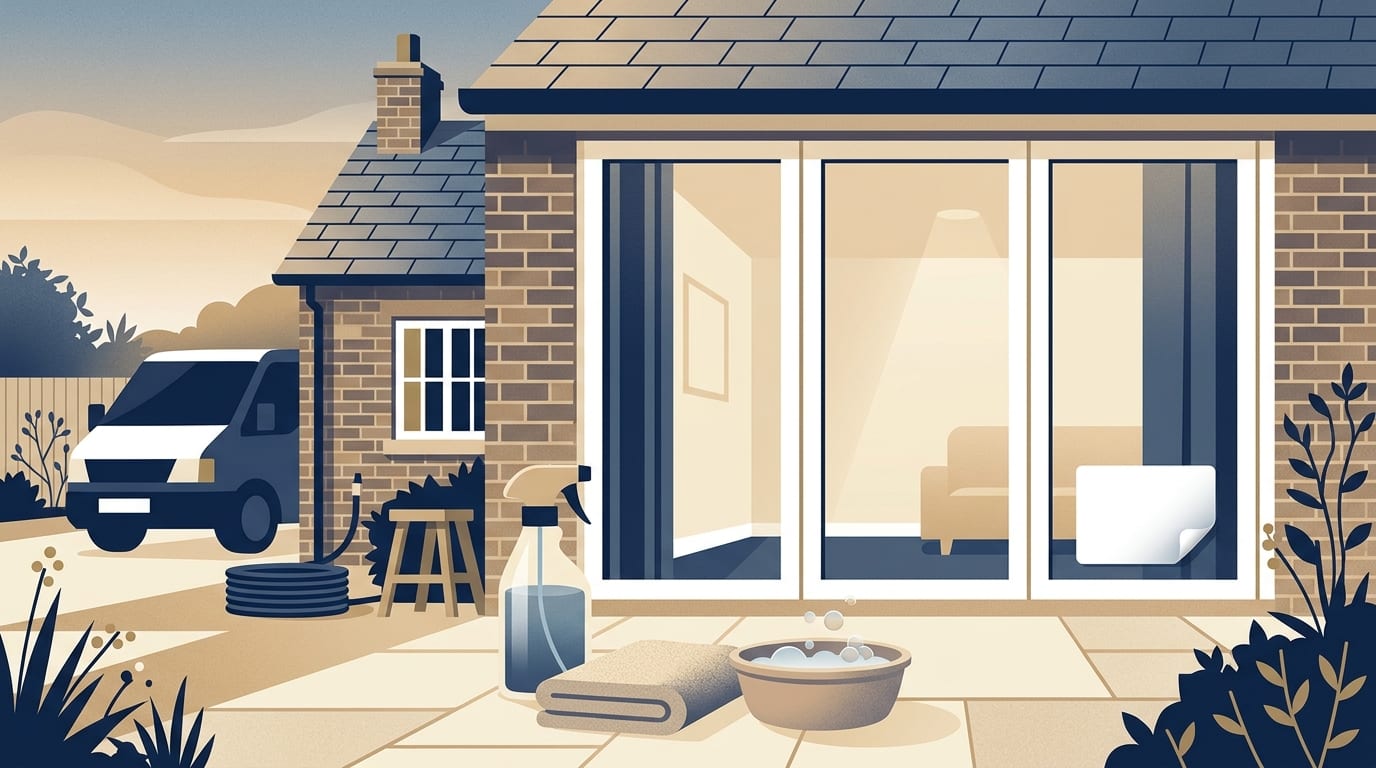
To remove sticker residue from glass safely, soak and lift the paper first with plenty of soapy water and a soft cloth. Use an organic solvent only for the glue that is left behind. You must keep metal blades away from toughened or coated glass to avoid permanent scratches.
Why stickers leave residue behind
Glass surfaces pick up a variety of residue during manufacture and installation. New windows, doors and conservatories often arrive with glass production labels and window manufacturers' labels stuck directly to the panes. Protective tape is also used during transit and fitting.
The adhesive used on these labels is designed to keep them attached during transport and poor weather. When you peel the paper or plastic away, the glue remains bonded to the glass.
The main risk when removing this residue is not the adhesive itself, but the dirt on the window. There is usually a layer of abrasive dust, sand and grit resting on the glass. If you apply too much pressure with a cloth or a tool while the glass is dry, this grit is dragged across the surface. Every type of glass can be scratched by an improper cleaning method.
Preparing to clean the window
Different types of glass require different cleaning methods. Glass in windows, doors and conservatories can be plain, non-coated, annealed glass, or it can be heat-strengthened or fully toughened glass.
Many modern units also feature specialist coatings. You might have self-cleaning glass that breaks down dirt, or energy efficient windows with low-emissivity coatings. Glass manufacturers warn against using blades on toughened or coated glass, and one says its warranty does not cover scratching.
You need plenty of clean water and a mild detergent to prepare the glass. You will also need several clean, lint-free cloths. Keep your cloths and any rubber squeegees clean and in good condition throughout the process to avoid rubbing dirt back into the glass.
To tackle the adhesive, you need an organic solvent. Suitable solvents for this job are isopropyl alcohol, methylated spirits, white spirit and acetone. These products remove marks left by tape adhesive, grease, oil, crayons and other waxy materials.
You must always clean a small area first and check that no damage occurs. If you are working on roof windows, the manufacturer guidance states that you must never try to clean dirt off the pane without first applying water. Keep all sharp or abrasive objects, including jewellery, away from the pane while you work, and avoid silicone contact with the glass.
Removing labels and glue step by step
This method allows you to soften the label and lift the residue without dragging grit across the glass.
- Rinse the glass thoroughly with clean water to remove dust, sand and loose grit.
- Flood the surface generously with a routine cleaning solution of mild detergent and water.
- Soak the paper label with the solution and peel it away gently.
- Apply a small quantity of organic solvent to a clean, wet cloth to spot clean the remaining adhesive.
- Rub only the affected area with the solvent cloth.
- Wash the area again with your routine detergent and water solution.
- Rinse the glass completely and wipe it dry with a clean, lint-free cloth.
Occasional spot cleaning is needed to remove stubborn marks left by transit tape or sticky pads. Always wet the surface with your routine cleaning solution first to remove grit. Do not apply the solvent to dry glass.
Put the solvent onto a wet cloth rather than pouring it directly onto the window. This stops the liquid running down the pane and gives you control over where it goes. Keep turning the cloth to a fresh part as the adhesive lifts off, so you do not smear the glue back across the glass.
Keeping solvents off frames and seals
You must take particular care to stop organic solvents contacting glass sealants, window framing and adjacent paintwork.
Window frames made from uPVC are particularly vulnerable to chemical damage. Cellulose thinners melt plastic and must never be used. One window maker's care guide lists the products to keep off uPVC.
The following products must never be used on uPVC frames:
- Glass cleaner and bleach.
- Methylated spirits and white spirit.
- WD40 and cream cleaners.
- Scouring powder or other abrasive cleaners.
- Caustic or ammonia-based cleaners.
- Steel wool.
- Scouring pads.
If you are using methylated spirits or white spirit to spot clean glass, keep your cloth well away from the edge of the pane. If any solvent drips onto the frame or the seal, wipe it away immediately with clean water. If you need to clean uPVC window frames, stick to warm soapy water and a soft cloth.
Why blades and scourers are a risk
One glass manufacturer says that using metal blades to scrape a window carries a large probability of irreparable damage, and recommends that metal blades are never used to remove materials from glass.
In published tests, cleaning with a steel blade and a rubber squeegee scratched both toughened and non-toughened glass, even when plenty of water was used. Razor blades and metal scrapers can create fine scratches that are only visible in full sunlight.
One glass manufacturer allows careful use of the flat edge, but never the corner, of a new safety razor blade to remove paint drops. This applies strictly to plain, non-coated, annealed glass. The same manufacturer rules out razor blades and metal scrapers entirely on heat-strengthened glass, fully toughened glass and coated glass.
Unless you are absolutely certain that your window is plain, non-coated, annealed glass, you should not use a blade. You must never use a scouring pad, wire wool or a sponge with a scouring surface on the glass.
Caring for specialist glass and film
Self-cleaning glass
Self-cleaning glass has a specific factory coating that requires careful handling. If you have dried paint, sealant, sticky marks or adhesive pads on this type of glass, you must use a different method.
Wet the mark with a solvent-soaked pad until the adhesive dissolves. You must not rub the mark. Keep the solvent off unaffected areas and reapply it using a fresh part of the cloth.
Suitable solvents are acetone, isopropyl alcohol, methylated spirits and white spirits. Follow this with a detergent wash and a water rinse. The factory coating in the cleaned area is reactivated after five to seven days.
You may notice fingerprints and the faint outline of labels on the glass after you finish. These will remain visible until the coating naturally breaks them down. Scratches caused by metal contact on self-cleaning glass cannot be put right, so keep blades and rings away from the surface.
Old window film
Window film is a clear polyester base that is dyed, extruded or metallised. It is applied to the inside or outside of glass to reduce glare, add privacy or control heat.
Professionally fitted film typically carries a warranty of around 10 years. An experienced technician is recommended for fitting, and you should ask the original installer about removal if the film is starting to peel or bubble.
If your glass has film applied, you must clean it like normal glass with a soapy water solution and a squeegee. Abrasives of any type will damage the film surface. Do not attempt DIY film removal, and do not use heat guns or hairdryers to melt the adhesive.
Fixing scratched window glass
If your glass is already scratched from an earlier attempt to remove a label, you have options. Surface damage to glass in windows, doors and conservatories can often be repaired by a glass repair specialist. They will survey the damage and provide a quote.
Replacing the glass entirely may be more economical than a repair in many cases. However, repair can be cost effective for large panes. Incorrectly removing paint or indelible ink can also damage the glass surface in the same way.
If a tradesperson scratched your glass while removing labels or tape, the Consumer Rights Act 2015 protects you. A trader must do the work with reasonable care and skill. If they have not, you can ask them to put it right.
If they cannot or will not fix the damage, you can ask for a partial or full refund. You should take photos of the scratched glass as evidence. Once a refund amount is agreed with the tradesperson, it should be paid within 14 days. Our guide to repairing scratched glass explains when repair is possible and when the glass needs replacing.
When to call a window cleaner
If you do not want to tackle stubborn labels on new windows yourself, you can ask a local window cleaner to do it during a first clean. You must point the labels out and agree the method and the price before they start.
Most domestic window cleaning is done on a round, where the same cleaner returns on a set cycle of every four, six or eight weeks. Work is priced per visit according to the size of the property, access, frequency, and the number and type of windows. It is not priced by the hour. A first clean or a one-off clean usually costs more than a regular visit, and London and the South East cost more.
Extras like inside glass, conservatory roofs, glazed doors, fascias and gutters are priced on top. You should agree exactly what is included in the price, especially if you want frames, sills or the conservatory cleaned.
A traditional cleaner uses an applicator, squeegee and cloth. Many cleaners now use the water-fed pole method, working from the ground with a telescopic pole and a brush head. The pole is fed with purified water from a tank in the van or a trolley. The glass is scrubbed, rinsed and left wet. Because minerals have been filtered out, the water is meant to dry without marks.
A first pole clean can leave some spotting until old residue has been rinsed out, so do not judge a pole clean purely on the first visit. Frames and sills are usually washed too during a pole clean.
If your cleaner uses a water-fed pole, industry guidance produced with the Health and Safety Executive (HSE) says poles must not be used near overhead power lines. You should point out any overhead cables to the cleaner when they arrive. Ladders are not banned. The HSE says ladders can be a sensible option for low risk, short duration work, including domestic window cleaning on lower floors. The Work at Height Regulations 2005 require work at height to be properly planned, done by competent people and avoided where reasonably practicable. The law asks for competence, not a formal qualification.
In Scotland most councils require window cleaners to hold a window cleaner licence under the Civic Government (Scotland) Act 1982, and licence holders carry identification. Requirements vary by council.
A reputable cleaner will have public liability insurance. This is not a legal requirement, but it is the cover that pays if a cleaner damages property or injures someone, so ask for a current certificate. Employers liability insurance is compulsory for a business with employees. Membership of the Federation of Window Cleaners, established in 1947, is voluntary, but their safety accreditation scheme, training and code of practice are one good sign among several.
Watch out for cold callers at the door who claim to be your usual cleaner and ask for payment. You should also avoid paying months in advance or accepting cleans carried out without agreement and followed by a bill. A service agreed on the doorstep, by phone or online normally carries a 14-day cooling-off period. A quote is a fixed price, whereas an estimate is not.
Common questions
How to get glue off glass without scratching?
Flood the glass with a mild detergent and water solution first to wash away abrasive dust and grit. Apply a small amount of organic solvent, such as isopropyl alcohol or methylated spirits, to a clean wet cloth. Spot clean the glue gently without rubbing it dry, then wash and rinse the area.
How to remove stickers from windows?
Soak the sticker thoroughly with soapy water until the paper softens, then peel it away gently. Do not use metal scrapers or razor blades, as these carry a large risk of irreparable damage to the glass. Use a safe solvent on a wet cloth to dissolve any adhesive left behind.
How to remove tape residue from glass?
Tape residue can be removed by applying a small quantity of white spirit or acetone to a wet, lint-free cloth and dabbing the affected area. Keep the solvent well away from uPVC window frames, rubber seals and painted surfaces to prevent permanent chemical damage.
How to remove window film?
Professionally fitted window film typically carries a warranty of around 10 years, so ask the installer who fitted it about removal.
What to do next
Before you start removing sticker residue, make sure you have the right materials and know exactly what glass you are working on.
- Check your window paperwork to see if the glass is toughened, heat-strengthened or coated.
- Wash the window generously with soapy water to remove abrasive grit.
- Soak the label and peel off as much paper as possible.
- Spot clean the glue with isopropyl alcohol or methylated spirits on a wet cloth.
- Wash and rinse the window again.
- Keep all solvents away from uPVC frames and rubber seals.
If your windows are high up or you are worried about scratching new glazing, you can hire a professional to complete a first clean. You can read reviews and find a window cleaner near you to clear the residue safely and set up a regular cleaning round.
Related Guides
How to Clean Decking and What a Professional Clean Costs
How to clean timber and composite decking without damaging it, what a professional deck clean costs in 2026 and when oiling or staining is worth adding.
Brick and Stone Cleaning Methods and What to Avoid
How brick and stone walls are cleaned, why the wrong method causes lasting damage, what a wall clean costs in 2026 and when you may need consent first.
How to Remove Water Marks and Hard Water Stains From Glass
Why white spots and limescale marks form on window glass, how to remove them without damage, when marks mean the glass is etched and how to stop them coming back.