
Render Cleaning Costs and Why Soft Washing Is Safer
TopRatedWindowCleaners.co.uk · 7 October 2026
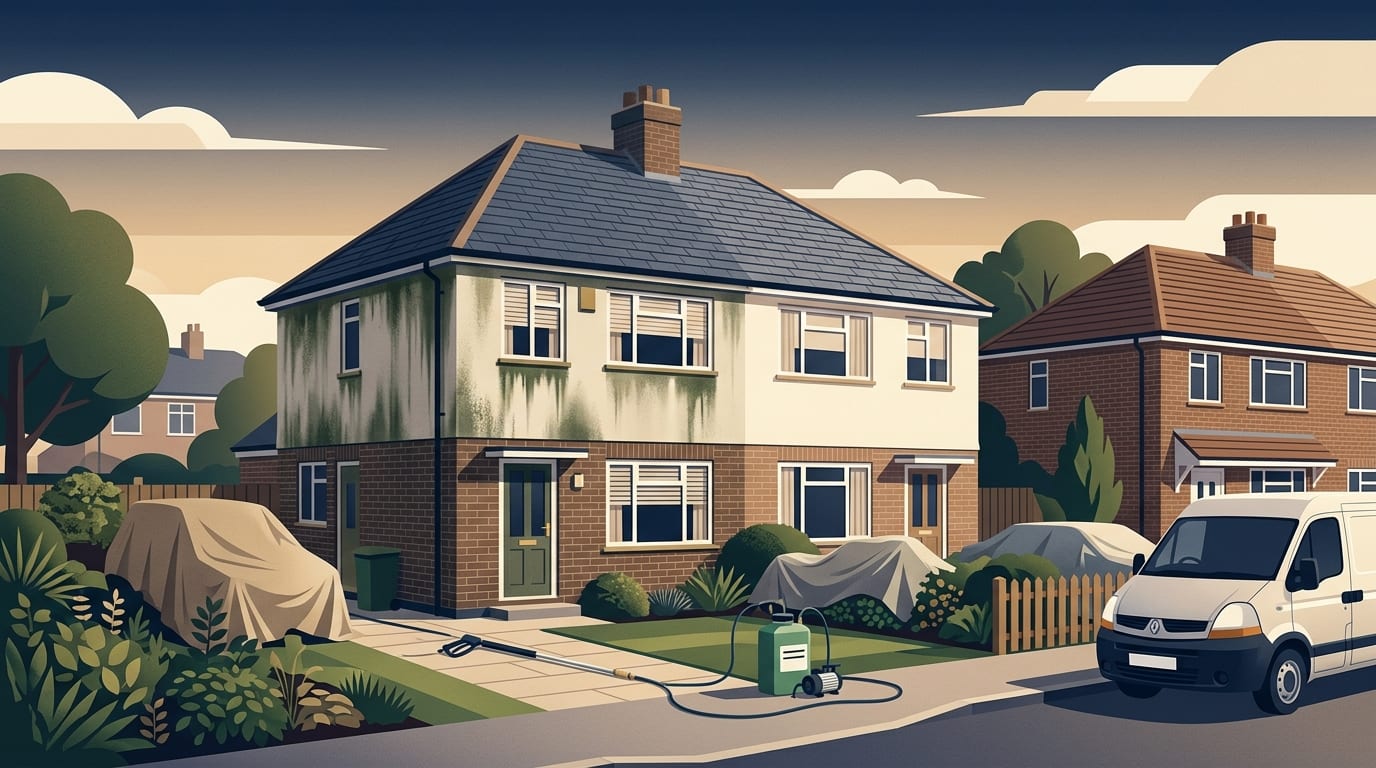
Professional render cleaning typically costs around £6 to £12 per square metre, and a semi-detached house usually costs £600 to £1,680, with an average of £1,140. Soft washing at low pressure is recommended for most renders because a high-pressure jet wash can damage the surface.
Why render goes green, black or red
Render discolours when dirt from the environment builds up on the surface or when biological growth takes hold. Road and air pollution cause black staining and leave a grimy film across the walls. Homes situated next to busy roads collect this pollution much faster than properties in quiet residential streets.
The damp UK climate strongly encourages biological growth on exterior walls. Spores settle on the render and grow into mould, fungus, algae and lichen. These organisms thrive in places that stay wet, particularly on heavily shaded walls or north-facing walls that see very little direct sunlight.
The colour of the staining depends on the specific organisms growing on the wall and your local climate. Homes in coastal areas and places with heavy rainfall tend to see much more red algae. Green and black stains are common across all regions where damp and shade allow algae and mould to spread.
Biological growth left in place can penetrate below the surface and keep the render damp. Algae and lichen also produce acids that can break down lime renders over time.
How much render cleaning costs
The total price for cleaning render depends on the size of your property, the type of house you live in, and how easy the walls are to reach. How dirty the render is also affects the price. A quote for this type of work is a fixed price, whereas an estimate is not.
The table below shows typical prices for cleaning the render on different sizes of property.
|
Property type |
Typical price range |
Average price |
|---|---|---|
|
Terraced house |
£420 to £1,080 |
£760 |
|
Semi-detached house |
£600 to £1,680 |
£1,140 |
|
Detached house |
£720 to £1,800 |
£1,260 |
These are typical published prices for 2026, and the actual quotes you get from local companies will differ.
The typical published rate for cleaning render is around £6 to £12 per square metre. The same range applies to washing exterior walls generally, which typically costs around £200 to £400 per wall depending on how dirty the brickwork or render is and how easy the wall is to reach. A full render cleaning job on a standard house usually takes one to two days to complete.
Prices are often higher if you live in London and the South East. If you agree to a cleaning service on your doorstep, over the phone or online, the agreement normally carries a 14-day cooling-off period.
What pushes the price up
Several extra services and access requirements will increase the final bill. Cleaners often offer to wash other parts of the property at the same time, so you will pay extra if you ask them to clean the soffits and fascias. Our guide to window cleaning prices explains how extras such as fascias are added to a bill.
Scaffolding adds a significant amount to the cost if your walls are difficult to reach safely. A small access tower typically costs £65 to hire. If the property requires full exterior scaffolding, this typically costs from £600 upwards.
Protective treatments are an optional extra that can help keep the render clean for longer. These treatments are applied after the wash and cost around £20 per square metre on average.
Minor repairs must be completed before the cleaning begins so that water does not penetrate the walls. Fixing small cracks and minor damage could add £200 to £300 to the total cost of the job.
Soft washing versus pressure washing
Soft washing is recommended for most render types because high-pressure jets can cause damage. High-pressure water can easily strip away render. It can also damage the protective coatings and colour of thin-coat render systems such as monocouche, silicone and acrylic renders.
Pressure washing can also contribute to cracking and drive water behind the render into the underlying walls. Brick and stone need care too, and our guide to cleaning brick and stone surfaces explains the gentler methods.
Furthermore, a jet wash may fail to kill the root growth and spores beneath the surface. This means the render can quickly discolour again as the organisms grow back.
Soft washing solves these problems by combining a low-pressure water flow with a biocide treatment or a mild detergent. The chemicals break down the dirt, algae and lichen, allowing the cleaner to rinse the wall gently without using destructive force. The biocide also helps to inhibit regrowth.
Some older buildings require a different approach. Older lime render may need cleaning with a soft brush and steam rather than chemical solutions. Certain renders also require a pH-neutral or acid-free cleaner to prevent chemical damage to the surface.
What a professional soft wash involves
A professional render clean is a careful, structured process designed to protect your property and the local environment.
- The cleaner carries out a thorough inspection to assess the render type and its current condition.
- They perform a porosity test and check the walls for existing cracks and damage.
- Any damaged areas are repaired first so that water and cleaning agents do not get into the structure.
- The cleaner identifies areas to protect, including air vents and plants around the base of the walls.
- If a chemical solution is used, they may set up a temporary dam to stop the run-off water reaching the drains.
- They erect scaffolding or set up access platforms for any hard-to-reach areas.
- The cleaner works from the top of the building down to the bottom, applying the biocide or mild detergent.
- The solution is left on the surface for 15 to 60 minutes to break down the dirt and biological growth.
- The walls are rinsed off at low pressure to remove the dead organisms and the chemical residue.
Heavy staining may need a second application later if the first wash does not lift all the marks.
Managing the chemical run-off is a critical part of the job. Government pollution prevention guidance for England states that any substance not found naturally in an environment could cause pollution, and this includes detergents. Surface water drains discharge directly to the environment.
A business must make sure that contaminated water from its activities goes into the foul drain with the water company's permission. Alternatively, the water must be recycled or removed by a registered waste carrier. Causing pollution can bring an unlimited fine.
How often render needs cleaning
Render typically needs cleaning every two to four years to maintain its appearance and prevent biological damage. The exact frequency depends heavily on your local environment and the type of render on your walls.
Walls exposed to heavy rain, north-facing walls, and walls overshadowed by trees stay damp for longer. These typically need cleaning every two to three years because algae and moss grow much faster in these conditions. Homes located next to busy roads collect dirt faster and will also need more frequent washing.
Renders manufactured with hydrophobic coatings naturally repel water, so they usually need cleaning less often. Biocide treatments applied during a soft wash also help to inhibit biological growth and extend the time before the next clean is required.
When cleaning is not enough
Cleaning will not fix blown render, crumbling sections, or deep cracks in the surface. Cracks and damage should be repaired before any wash, so that water and cleaning agents do not get into the structure.
Small issues and hairline cracks can be repaired before the wash begins. However, larger problems mean the wall needs re-rendering. If your render is falling away in chunks, you will need to hire a plasterer to replace the damaged sections before you consider cleaning the rest of the exterior.
Can you clean render yourself?
Cleaning render yourself is only practical for very small patches of staining that are easy to reach from the ground. You can clean these minor marks using a soft brush and a mild detergent. This is the only type of render cleaning you should attempt yourself.
Do not use a domestic pressure washer on your walls. High pressure can strip the coating, damage the colour and force water behind the surface.
You should also avoid working from a ladder. Anything you cannot reach from the ground with a soft brush is a job for a professional.
Do not use harsh chemicals or attempt to mix your own cleaning solution. The wrong product could damage the colour or protective coating of your walls.
Protections and rules when hiring
Employers' liability insurance is compulsory for a business with employees. Public liability insurance is not a legal requirement, but it is the cover that pays if a cleaner damages your property or injures someone. You should ask to see a current certificate before they start work.
The Federation of Window Cleaners, established in 1947, is a non-profit trade body with a code of practice, a safety accreditation scheme and training. Membership is voluntary, so you should treat it as one good sign among several when choosing a tradesperson.
Industry guidance produced with the Health and Safety Executive says water-fed poles must not be used near overhead power lines. Point out any overhead cable to the cleaner before they set up their equipment.
For work at height, the law asks for competence rather than a formal qualification. In Scotland, most councils require window cleaners to hold a window cleaner's licence under the Civic Government (Scotland) Act 1982, and licence holders carry identification. Requirements vary by council.
Be wary of cold callers offering exterior cleaning at the door, and never let anyone start work on your walls until the price and method are agreed.
Common questions
What is soft washing?
Soft washing is a low-pressure cleaning method that uses a biocide or mild detergent to remove dirt and biological growth. It is recommended for delicate exterior surfaces because it cleans effectively without the destructive force of a high-pressure jet wash.
How do you clean rendered walls safely?
Rendered walls should be cleaned using the soft wash method. The cleaner applies a suitable chemical solution, leaves it to break down the dirt and algae, and then rinses it away at low pressure.
What is softwash solution for render?
The solution used depends on the render type and the level of staining. Professionals typically use a mild detergent, a biodegradable biocide, or a hypochlorite biocide. Some renders need a pH-neutral or acid-free cleaner, and some older lime renders are cleaned with a soft brush and steam rather than chemicals.
Why does my render have red stains?
Red staining on exterior walls is caused by a specific type of red algae. This algae thrives in damp environments, which is why homes in coastal areas and places with heavy rainfall tend to see more red algae on their render.
Checklist before you hire a render cleaner
Before you book a professional, use this checklist to make sure they will treat your property correctly and safely.
- The company should visit your property before quoting for the work.
- A render porosity test should be carried out during the visit.
- The company should confirm it uses soft washing rather than pressure washing.
- The cleaner should explain which products they will use, such as a mild detergent, biodegradable biocide, hypochlorite biocide or another solution.
- They must confirm the chosen products are safe for your specific render type.
- Check whether plants around the base of the walls will be protected from the chemical run-off.
- Ask whether minor repairs are included in the quote or if they will cost extra.
- Confirm the company holds public liability insurance covering accidental damage to your property and neighbouring properties.
Other exterior areas such as soffits and fascias can often be cleaned at the same time, so ask the cleaner to include these in the fixed quote if needed.
Under the Consumer Rights Act 2015, a service must be carried out with reasonable care and skill. Citizens Advice states that if the work is not up to standard, you can ask the trader to put it right. If they cannot or will not fix the issue, you can ask for a partial or full refund.
Take photos of your walls before and after the clean as evidence of the work. Once a refund amount is agreed with the trader, it should be paid within 14 days.
If you are ready to get quotes for your property, find a window cleaner near you to discuss your render cleaning needs.
Related Guides

Driveway and Block Paving Cleaning Costs Explained
What driveway and block paving cleaning costs in the UK in 2026, what a proper job includes from pre-treatment to re-sanding and sealing, and how to avoid damage.
Patio Jet Washing Costs and How to Protect Your Paving
What patio jet washing costs per square metre in the UK in 2026, how each type of paving should be cleaned, and what re-sanding and sealing add to the bill.

Solar Panel Cleaning Costs and Whether Your Panels Need It
What solar panel cleaning costs in the UK in 2026, whether rain is enough to keep panels clean, and what a professional clean should include.